
General Medicine in Australia
This section will address how to select which program you should attend.
MOTIVATIONS FOR DEGREE
Studying medicine, although rewarding in the long run, can be challenging and rigorous – no matter which country you choose to pursue it in. You will be required to invest almost a decade into completing the relevant study and training needed to help you become a doctor. Entry into medical schools and programs, specifically in Australia, can be competitive – so you will need to work extremely hard. Even after you gain entry, you will need to demonstrate a high amount of perseverance to satisfactorily complete your degree and training.
There may be other options around the world that may be easier to get into, or less expensive. Getting into medical school in Australia is not easy — and if you do not get high grades and test scores, it can be difficult to get into the top medical schools. It is recommended that you look at other programs being offered around the world and within Pakistan, compare them with one another, and then decide which one to apply to.
But before you start your research, you should acquaint yourself with the different stages an aspiring doctor in Australia goes through.
MEDICAL CAREER PROGRESSION AND PATHWAYS IN AUSTRALIA
- Medical Student: Medical students in Australia will typically spend 4-6 years in medical school (either through undergraduate entry or graduate entry). Most medical schools in Australia follow a similar structure and syllabus: the first 1-3 years are dedicated to pre-clinical study, which is typically classroom-based learning. Students can expect to develop foundational medical knowledge of anatomy, physiology and pharmacology in these years — whilst developing basic clinical skills. The next 2-3 years usually focus on hospital or clinic-based learning: students can expect to have clinical placements in various specialties and can observe and learn from veterans/professionals directly.
- Intern: After graduation, students are required to satisfactorily complete 12 months of supervised practice as an intern — after which they are eligible for general registration. Note: as an international student, you will typically find it difficult to land an internship after completing your degree – and may need to apply for one overseas or back in Pakistan. It is highly recommended that you get in touch with your prospective university to find out if and how you can satisfy the internship requirement as an international student.
- Resident: After satisfactorily completing the internship, doctors in Australia have to spend a further 1-2 years working in a hospital (or a community-based health setting) to gain more clinical experience in a variety of different settings, with increased responsibility. Residency in Australia is considered to be pre-vocational, and it is usually after its completion that doctors can gain entry into specialist medical colleges.
- Registrar/Trainee Specialist (also known as Junior Doctors): after successfully completing the internship and an additional 1-2 years of residency (and meeting the entry requirements for the relevant specialty college), doctors in Australia can apply to specialist medical colleges. Some specialist medical colleges may be willing to accept students immediately after their internship, but most will require their students to have received residency training. Specialist training, including examinations, can take 3-7 years to complete.
- Hospitalists: these are generalist medical practitioners who are typically beyond the internship and residency phases of their career – but have decided not to do a specialization.
- General Practitioner/Consultant Specialist: after successfully finishing the relevant specialized medical training, doctors will be awarded a Fellowship of the specialist medical college, and will have satisfied all the necessary education and training required to be fully qualified for that specialty.
You can find this information presented in a flowchart below.
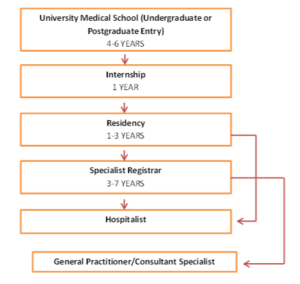
If you wish to apply for an undergraduate or graduate medical degree in Australia, you can apply through the Pre-Vocational track. If you have already completed your medicine degree (and your internship and 1+ additional years as a Resident), you can apply through the vocational track to a recognized medical specialty training program. Enrolling in a medical specialty training program is the necessary training you need to obtain a fellowship at one of the recognized specialist medical colleges. It also enables you to practice medicine independently.
PRE-VOCATIONAL TRACK
UNDERGRADUATE ENTRY
Undergraduate Medical Programs are typically 5-6 years long. You can apply for these directly after finishing high school (A-Levels/IB/Secondary School). There will be some entry criteria that you will need to satisfy before applying (test scores and grades). These will be elaborated upon in other sections.
GRADUATE ENTRY
Graduate Medical Programs are for those students who have already completed an undergraduate degree (or are in their final year, and will complete their study before the program begins). The undergraduate degree does not need to be medicine-oriented. These programs are typically 4 years in length, and 2 of those years are usually devoted to clinical training. Note: if you choose to go through the graduate entry track, you will need a previous undergraduate degree (3-4 years) and a medical graduate degree (4 years) – so it will take you at least 7-8 years to finish your studies.
After completing your medical degree, you might be able to work as an intern on PGY1 in Australia (note: it is difficult for international students to secure internship placements within Australia). The internship will typically be 12 weeks long and will usually be undertaken in a public hospital (but training can also take place in general practice settings, community-based settings and private hospitals).
INTERNSHIP
Information for this section has been taken from the Australian Medical Association
As an intern, you can expect to do a series of rotations – which are designed to expose you to a range of clinical situations and environments. The internship stage – no matter where you end up doing it – is critical in helping you decide what you want to specialize in: you will gain experience in different medical specialties and will be able to choose what appeals to you most. This will typically be a one-year long training and is known as “PGY1” – or your first year of postgraduate.
Internships in Australia will typically include the following:
| 8 weeks – Emergency Medical Care |
|
| 10 weeks – Medicine |
|
| 10 weeks – Surgery |
|
| 19 weeks – A range of other approved positions |
|
When you successfully complete your internship you will receive general medical registration through the Medical Board of Australia (MBA).
RESIDENCY
After finishing their internship, a number of doctors choose to spend at least one more year working in public hospital settings — as a means of gaining more clinical experience whilst handling a greater amount of responsibility. This work helps doctors gain the prerequisite experience and procedural skills that are required for entry into specialist training programs.
There may be some specialist medical colleges that can accept entrants after they have successfully completed one year of postgraduate. However most prefer applicants to have completed a second or third postgraduate year (PGY2 or PGY3). Doctors receiving on-the-job training in these years are broadly known as “Residents”.
VOCATIONAL TRACK
SPECIALIST TRAINING
Specialist colleges typically have clinical, practical and exit exams (and some other assessments) which are used to evaluate if the candidate has all the skills and behaviors that doctors are required to have (including skills like communication and teamwork).
These training programs and the corresponding examinations are administered and conducted by individual colleges, and can typically take any time between 3 and 7 years to satisfactorily complete (dependent on the specialization you choose to apply for).
Training for most medical specialties will usually take place in a public hospital — but can also include a number of rotations in private hospitals, regional, rural and community health sections. (Unless you are applying for general practice — in which doctors will have most of their training done in designated private general practices in a community setting). You can find more information on the different kinds of specializations you can apply for in the Program Selection selection.
Note: some doctors choose not to go to a specialist medical college, and instead decide to become a hospitalist (more information on this in Program Selection).
International Students
If you have done your medical degree, and internship outside Australia, and are hoping to apply for specialist training in Australia, you will have to take one of the following assessment pathways, to register through the Medical Board of Australia:
- Competent Authority Pathway
- Standard Pathway
- Specialist Pathway
- Short-term training
You can find more information on each of the pathways in the table below.
| Competent Authority Pathway | If you are an international medical graduate (IMG) and have not yet done your specialization, and are seeking general registration with the Medical Board of Australia, you can apply for the Competent Authority Pathway. For this pathway, you will need to have completed the requirements of a ‘competent authority’ as defined by the Medical Board of Australia (MBA). For more information, please click here. |
| Specialist Pathway | If you are an IMG who has received their specialty training outside of Australia and want to work in Australia (i.e. apply for a specialist-level position or gain specialist recognition), you should apply for this pathway. For this pathway, you need to have a primary qualification in medicine and surgery awarded by a training institution recognized by the Australian Medical Council and World Directory of Medical Schools. You also need to have satisfied all the training + examination requirements that are needed to practice in your field in your country of training. For more information, please click here. |
| Standard Pathway | If you are an IMG who is not eligible for the Competent Authority or Specialist Pathway, you should apply for the Standard Pathway. For this pathway, you need to have a primary qualification in medicine and surgery awarded by a training institution recognized by the Australian Medical Council and World Directory of Medical Schools. For more information, please click here. |
| Short-term Training in a Medical Speciality Pathway | If you are an IMG who has completed their specialization or are currently a specialist-in-training and want to take on specialist/advanced training in Australia (for a short period – usually of up to 24 months), you should apply for this specific pathway. For more information, please click here. |
You can find a self-assessment flowchart below — to determine which pathway you can apply for, if you wish to practise medicine in Australia (taken from Medical Board of Australia).
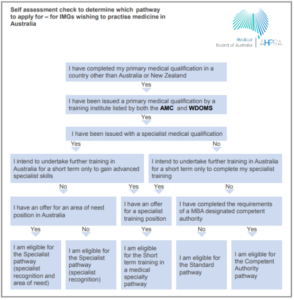
Once you have determined which pathway you can apply for, you can begin the registration process. To access a simplified flowchart on what each pathway requires, click here.
TYPES OF DEGREE
In a nutshell, the following degrees + specializations are available for Medicine in Australia:
- Undergraduate Medicine
- Bachelor of Medicine, Bachelor of Surgery (MBBS) – 6 years
- Bachelor of Dental Surgery (BDS/BChD)
- Bachelor of Medical Sciences (BMedSc/BMedSci)
- Graduate Medicine
- Doctor of Medicine (MD)
- Master of Dental Surgery (MChD)
- Specialist Medical Programs (after residency)
Please note: you are only eligible for Internships, Residency and Specialist Medical Programs after you have satisfactorily completed a degree in medicine.
PROGRAM SELECTION
How to select the best option for yourself (among degrees/programs within this field)
UNDERGRADUATE VS. GRADUATE ENTRY
If your high school grades are not competitive enough and you are set on pursuing medicine in Australia, it is recommended that you consider completing an undergraduate degree first – and then apply to a graduate medical school in Australia. Your undergraduate degree does not need to be in medicine (you can study any Science-based degree — in some cases, a non-science degree may also be accepted!): if you can manage to get a competitive undergraduate CGPA/grades and do well on the entry tests, you will have a much better chance of getting into medical school. After finishing your undergraduate degree, you can apply for a graduate degree in Medicine.
If your high school grades are high enough, and you are sure you want to study Medicine immediately, then you can apply for an undergraduate medicine degree directly. An undergraduate degree will require 1-2 years more than the graduate degree (but the graduate degree requires you to have completed a Bachelor’s degree already).
Each path offers a slightly different approach to studying medicine. Before applying, you should take some time to decide what your preferred entry type is, what your choice of university is, and what your future plans are.
INTERNSHIP/RESIDENCY
How to choose where to do your internship
HOSPITALISTS VS. SPECIALISTS:
Why you should (or should not) go to specialist medical school
There are a number of reasons why doctors choose not to go to specialist medical school and instead become hospitalists. For instance, if you have no intention of specializing during your medical career and simply prefer working as a non-specialist hospital clinician, you should consider forgoing specialist school. If you are not meeting the prerequisites for the specialist school you are interested in attending, you can consider becoming a hospitalist. Other reasons why you would choose to become a hospitalist include: intending to specialize at a later point but not currently, deciding to seek non-specialist employment after finishing specialty training, or taking a temporary leave from specialty training – and working.
However, if you are convinced that you want to specialize, then you should a) find the specialty colleges that appeal most to you, and b) try to meet all its prerequisites.
FIELD/SUB-FIELD SELECTION
How to select the best option for yourself (among specializations and sub-fields within this field)
DENTAL DEGREES VS. MEDICAL DEGREES
SPECIALIZATIONS
Some of the areas you can specialize in are listed below. Read further to find out more about what the specialization entails, what the entry requirements are, how to apply, length of study, and assessments. Note: this is not an exhaustive list — for information on other specializations, please click here. This link also enables you to select and compare different specializations (by selecting the specializations you wish to compare, and then clicking the green ‘compare’ button).
- Cardiology (Adult)
- Cardiology (Pediatrics)
- Dermatology
- General Paediatrics
- General Practice
- General Surgery
- Gynecological Oncology
- Medical Oncology
- Neurology
- Neurosurgery
- Ophthalmology
- Orthopaedic Surgery
- Pediatric Surgery
- Psychiatry
- Radiology
You should select your specialization on the basis of: a) your interest – and the kind of practice you have engaged with in your internship and residency, b) the entry requirements (and whether or not you meet those criteria), c) the cost and length of study, d) your future plans (do you plan on staying in Australia after finishing your qualification? Do you plan to become/already are an Australian or New Zealand Permanent Resident?) and finally e) the career pathway you want to have.
In the section below, you can find out a summary of each specialization/career pathway. Go through these tables to find out a summary of what the specialization is, what the application cycle is like, how training is conducted, and the kinds of assessments you need to take.
| CARDIOLOGY (ADULT) Cardiology is the branch of medicine that is concerned with the prevention, investigation, therapy and research of disease that involves the cardiovascular system. | |
| Application Cycle | Applications need to be submitted by:
|
| College | Royal Australiasian College of Physicians For more information, please visit the college website. |
| Entry Requirements |
|
| Training Time | Total Time: 6 years Basic Adult Medicine Training: 3 years Advanced Training: 3years You will typically be required to do 36 months of full-time Basic Adult Medicine training. Out of these 36 months, 24 months (i.e. 2 years) will be spent in core training (including training in general and acute care medicine and medical specialties). You can also expect to spend some time in a Level 3 Teaching Hospital, and a few months outside it. After this, 36 months of full-time core training will be required. |
| Required Assessments | You can expect to have 5-10 assessments per year — in both your basic training and advanced training periods. In Basic Training, the following will typically be required: 1 ward/service consultant report per rotation, 4 mini-clinical evaluation exercises per year, an annual progress report per year, the divisional written examination and the divisional clinical examination. In Advanced Training, the following will typically be required: 1 final supervisor’s report per rotation, a mid-year progress report (for 12 month rotations), 2 case-based discussions per year; 2 direct observations of procedural skills per year, a completed procedural logbook, 1 published article or presentation, 2 quality assurance/audits, 1 electrophysiology supervisor’s report, 1 cardiothoracic surgical training supervisor’s report. |
| CARDIOLOGY (PAEDIATRICS) Cardiology is the branch of medicine that is concerned with the prevention, investigation, therapy and research of disease that involves the cardiovascular system. Paediatric Cardiologists are sub-specialist cardiologists who are experts in diagnosing and managing cardiac disorders and multisystem disorders. | |
| Application Cycle | Applications need to be submitted by:
|
| College | Royal Australiasian College of Physicians For more information, please visit the college website. |
| Entry Requirements |
|
| Training Time | Total Time: 6 years Basic Paeds and Child Health Training: 3 years Advanced Training: 3years You will typically be required to do 36 months of full-time Basic Paeds and Child Health training. Out of these 36 months, 24 months (i.e. 2 years) will be spent in core training (including training in general paediatric medicine, pediatric emergency medicine, neonatology, and training in paediatric medical specialty). You can also expect to spend sometime in a Level 3 Teaching Hospital. After this, 36 months of full-time core training will be required. |
| Required Assessments | You can expect to have 5-10 assessments per year — in both your basic training and advanced training periods. In Basic Training, the following will typically be required:
In Advanced Training, the following will typically be required:
|
| DERMATOLOGY Dermatologists, in Australia, are required to look after patients of all age-groups (infants – adults) and typically spend a substantial amount of time treating a variety of skin-related disorders caused by sun exposure. They are considered to be experts in the diagnosis and management of disorders affecting all areas that are classified as skin. | |
| College | Australiasian College of Dermatologists For more information, please visit the college website. |
| Entry Requirements |
|
| Application Cycle | Applications need to be submitted by:
|
| Training Time | Total Time: 4 years Basic Training: 2 years (full-time) Advanced Training: 2 years (full-time) |
| Required Assessments | You can expect to have 5-10 assessments per year — in both your basic training and advanced training periods. Basic Training will typically include the following assessments:
Advanced Training will typically include the following assessments:
|
| GENERAL PRACTICE You should only consider applying for this if you hope to (and can) become an Australian Permanent Resident since those are the only individuals who are eligible to enter this pathway. A GP (i.e. a General Practitioner) is involved in providing patient-centric, constant, comprehensive, and coordinated health care to individuals/families/communities. In Australia, a GP:
| |
| College | Royal Australiasian College of Practitioners For more information, please visit the college website. |
| Entry Requirements |
|
| Application Cycle | Applications need to be submitted between April and June. Applicants can apply in PGY1 in April/May for the training program in PGY2. |
| Training Time | Total Time: 3 years This will include:
You may also choose to do an optional 4th year of training in advanced rural skills training |
| Required Assessments | You can expect to have less than 5 assessments in this pathway per year. You will be required to take the Fellowship Examination which will include 3 different segments, included:
You will need to pass the AKT and KFP before you take the OSCE. For more information on these tests required for the GP, please go through this link. |
| NEUROSURGERY You should only consider applying for this if you hope to (and can) become an Australian Permanent Resident since those are the only individuals who are eligible to enter this pathway. If you are interested in the operative and non-operative management of disorders that affect the central, peripheral and autonomic nervous system (including their supportive structures and vascular supply. This includes the prevention, diagnosis, evaluation, treatment, critical care and rehabilitation and operative/non-operative management of pain. | |
| College | Royal Australiasian College of Practitioners For more information, please visit the college website. |
| Entry Requirements |
|
| Application Cycle | The application cycle is divided into 5 sections: Step 1: Selection Registration (January-February) Step 2: Selection Application (March-April) Step 3: Reference Reports Collection (April-May) Step 4: Interviews (June/July) Step 5: Offers Announced (July) |
| Training Time | Neurosurgery requires at least 5 years of full-time training and maximum 9 years. The training is divided into basic training, intermediate training, advanced training. |
| Required Assessments | There will typically be less than 5 assessments per year. The basic training will usually include the following assessments:
The advanced training will usually include the following assessments:
|
| PSYCHIATRY If you are interested in looking at and treating a patient’s physical and mental symptoms and needs holistically, this pathway might be suitable for you. As a Psychiatrist, you can expect to do the following: study and treat the effects of emotional disturbance on the body, and the effects that physical conditions/ailments/injuries etc. can have on the mind. | |
| College | Royal Australiasian and New Zealand College of Psychiatrists For more information, please visit the college website. |
| Entry Requirements |
|
| Application Cycle | |
| Training Time | Psychiatry will require at least 5 years of training, divided into 3 sections:
|
| Required Assessments | There will typically be less than 5 assessments per year. You will typically need to take:
|
| RADIOLOGY If you are interested in the diagnosis and treatment of a patient through the use of medical imaging (like X-ray, CT, MRI, Ultrasound, and nuclear medicine imaging techniques), this may be the right pathway for you. | |
| College | Royal Australian and New Zealand College of Radiologists For more information, please visit the college website. |
| Entry Requirements |
|
| Application Cycle | |
| Training Time | Total Time: 5 years minimum This will include:
|
| Required Assessments | You can expect to have less than 5 assessments per year. The assessments you can expect to have include:
|
| OPHTHALMOLOGY (ADULT) You should only consider applying for this if you hope to (and can) become a Resident of Australia (or New Zealand), since those are the only individuals who are eligible to enter this pathway. If you are interested in gaining specialist training in the diagnosis and management of eye/visual system disorders, you can consider this pathway. Ophthalmology will train you to: provide complete eye care (including prescription of glasses/contact lenses, medical treatments and complex microsurgery). A number of ophthalmologists also choose to get involved in scientific research – by studying the causes and cures for eye disease and vision problems. | |
| College | Royal Australian and New Zealand College of Ophthalmologists For more information, please visit the college website. |
| Entry Requirements |
|
| Application Cycle | Applications need to be submitted by:
|
| Training Time | Total Time: 5 years Basic Training:2 years full-time Advanced Training: 2 years full-time Final Year Training:1 year full-time |
| Required Assessments | You will typically be required to have less than 5 assessments per year.
|
| MEDICAL ONCOLOGY If you are interested in specializing in the investigation, study, diagnosis, management and treatment of benign and malignant tumors, growths, cancers and diseases, this pathway may be suitable for you. | |
| College | Royal Australasian College of Physicians For more information, please visit the college website. |
| Entry Requirements |
|
| Application Cycle |
|
| Training Time | Total Time: 6 years Basic Adult Medicine Training: 3 years OR Basic Paediatric and Child Health Training: 3 years Advanced Training: 3 years Basic Adult Training will include: minimum 2 years of full-time core training, |
| Required Assessments | You can expect to have 5-10 assessments per year — in both your basic training and advanced training periods. Basic Training
Advanced Training
|
| PAEDIATRIC SURGERY You should only consider applying for this if you hope to (and can) become an Australian Permanent Resident, since those are the only individuals who are eligible to enter this pathway. Paediatric surgeons are those specialists who have training in looking at conditions of children (which may require surgery). Specialist paediatric surgeons normally deal with non-cardiac thoracic surgery, general paediatric urology. | |
| College | Royal Australasian College of Surgeons For more information, please visit the college website. |
| Entry Requirements |
|
| Application Cycle | The application cycle is typically divided into 5 stages:
|
| Training Time | Total Time: 7 years Early SET: 3 years full-time Mid and Late SET: 4 years full-time The Early SET will include 3 years of full-time training, in which 1 year will be spent in Paediatric surgery training and the next 2 years will be spent in Operative surgery training. The Mid and Late SET will include 4 years of full-time training in accredited speciality Paediatric Surgical Training posts. |
| Required Assessments | You can expect to have 5-10 assessments per year — in all three SETs (Early, Mid and Late) In the Early SET, you will typically have to take the following assessments:
In the Mid SET, you will typically have to take the following assessments:
In the Late SET you will typically have to take the following assessments:
|
| GYNAECOLOGICAL ONCOLOGY If you are interested in becoming a specialist in obstetrics and gynecology, you can consider following this pathway and get your certification. As a gynecological oncologist, you will be able to treat women who have a genital malignancy. Gynecological oncologists will have to spend at least two-thirds of their time in gynecology in gynecological oncology. These specialists are also required to submit for recertification every 3 years, and only those who are actively participating in gynecological oncology will receive the recertification. | |
| College | Royal Australian and New Zealand College of Obstetricians and Gynaecologists (RANZCOG) For more information, please visit the college website. |
| Entry Requirements |
|
| Application Cycle | You can apply between January and March in Year 4 of your training. |
| Training Time | Total Time: 3 years full-time training These 3 years will include:
|
| Required Assessments | You can expect to have less than 5 assessments per year in this pathway. The assessments are listed below:
|
| GENERAL SURGERY You should only consider applying for this if you hope to (and can) become an Australian Permanent Resident since those are the only individuals who are eligible to enter this pathway. General Surgery is the broadest of all surgical specialties. A General Surgeon is a surgical specialist who is responsible for the care of surgical patients. Sometimes, a General Surgeon may be required to have knowledge of the whole field of surgery — and is typically the first point of contact for a patient who is acutely ill/injured. | |
| College | Royal Australasian College of Surgeons For more information, please visit the college website. |
| Entry Requirements |
|
| Application Cycle | The application cycle is typically divided into 5 stages:
|
| Training Time | Total Time: 5 years full-time You will need to complete 5 SETs.
|
| Required Assessments | You can expect to have less than 5 assessments per year.
|
ALLIED FIELDS
If you are interested in Medicine, you should also go through:
- Medicine in the UK
- Medicine in the US
How to select the best option for yourself (among allied fields)
ACTION-STEPS/RESOURCE
- No. of Universities to Apply:
Here is a list of all the universities that offer Medicine (Undergraduate and Graduate Entry):
Top programs:
Here are some links that could help you with:
- Top program by specialty: make sure to check the ranking of programs based on their specialty/subfield in Medicine.
Complement the above field-specific tips with general tips on program selection (under the tab of ‘selection’).
A lot of our tips talk about how you can strengthen your application, but you can build a stronger application when you’ve done the things this program values in the years prior to the application. The application itself is the communication part (in which you communicate what you’ve done to the admission committee), but this section gives guidance on the substance part (what you can actually do before you apply). In this section we talk about what you can do in the years leading up to applying that can make you an ideal candidate. Supplement the following tips with general tips (under the tab of ‘Pre-Application’) to become a competitive applicant.
ACADEMIC BACKGROUND
Subject/Degree Requirement:
Undergraduate Entry:
Most universities will require you to have studied Mathematics, Chemistry and Biology in your final years of high school. Some universities may also recommend studying other related subjects like Physics. For more information, please visit your prospective university website.
Graduate Entry:
If you are interested in applying for Graduate Entry Medicine Programs, you should ideally have an undergraduate degree in any field of Science. Some universities may also accept non-science degrees. For more information on what your prospective university requires, please visit its website.
GPA /Grade Requirement:
Undergraduate Entry
- A-Levels: Requirements for medical degrees in Australia are extremely high. You should aim to get grades between AAB and A*A*A. Specific requirements will vary by university. The most competitive universities may require 2-3 A*s. For more information, please visit your prospective university website.
- IB: you should aim to have a minimum score of 35 points. The most competitive places can require scores of 42-43 points. Note: this is a general overview. Please check your prospective university website for more precise grade requirements.
- Other: please visit your prospective university website to find out if it accepts other systems, and if so – what the minimum score/grade requirements are.
Graduate Entry:
Please visit your prospective university website to find out what the exact grade requirements are for graduate entry.
This section provides an overview of general guidelines pertaining to the application process. It also delineates the key components of the application process.
GENERAL ADVICE
This section contains advice on the components required for undergraduate and graduate entry study in Medicine, in Australia.
In order to be eligible for Medical School in Australia (Graduate Entry Medicine + Undergraduate Entry Medicine) in Australia, you will need to:
- Have completed your high school with high/competitive grades or an undergraduate degree with a high GPA (or its equivalent),
- Meet the minimum criteria in the aptitude/entry tests.
Usually, if you meet these criteria, you will be called for an interview. Specific GPA requirements and test score requirements will, of course, vary by university. Before applying, you should make sure that you are meeting your prospective university/course minimum requirements.
Medical Universities in Australia typically do not require statements of purpose or reference letters — but it is highly recommended that you visit your prospective university website and double-check the requirements there.
Refer to the Program Selection Section for further information.
COMPONENTS
| Component | Is this component required? | How important is this component (in the overall review of the application for admission)? |
| Overall Application Deadline | MBBS and all other undergraduate applications take one batch of students each year. Applicants are typically open between June and September (specific deadlines vary by university). | |
| Standardized tests or entry exams | Entry Tests: Required Standardized Tests: Required | Very important |
| Transcripts (past academic records) | Required | Very important |
| Letters of recommendation | Usually not required | Important if required |
| Personal Statement | Usually not required | Important if required |
| Resume or CV | May be required | Important |
| Interviews | Required | Very important |
Essays or personal statements are typically not required for medical school applications in Australia. The admissions committees base admission on three components: grades, test scores and interview performances. You are, however, advised to visit your prospective medical school website — and find out if any essay/statement submission is required. If it is required, follow the instructions provided on the website and write your statement accordingly.
Letters of recommendation are typically not required for medical school applications in Australia. The admissions committees base admission on three components: grades, test scores and interview performances. You are, however, advised to visit your prospective medical school website — and confirm that no reference letters are required. If they are required, follow the instructions provided on the website.
This section will cover everything else related to the application process; including transcripts, interviews, resumes, and standardized tests.
INTERVIEWS
Basic Information:
Some interviews require the applicant to attend them in person. Others may be conducted online. It is recommended that you get in touch with your prospective university to find out what the interview procedure for your university is. Focus on asking the following questions: a) do interviews typically take place? b) if so, are they for all applicants or shortlisted applicants? c) is the interview conducted in-person or online? d) how are international applicants accommodated in in-person interviews? and e) what format does the interview typically follow?
You can expect the interview to typically be of one of the following formats (or a combination of them):
- Multiple Mini Interview (MMI)
- A number of universities use the MMI format. MMI interviews consist of 6-10 small panel interviews, each taking place at different stations. In this format, applicants are assessed by trained interviewers.
- You can expect to receive a series of scenarios, and questions based on those scenarios. The interviewers will be evaluating your answers and will be looking for some of the following skills (and more): critical thinking, ethical reasoning, motivation, collaboration, empathy, communication, teamwork, awareness of health issues etc.
- Each mini-interview will typically assess you on 2-3 qualities.
- You can expect to be asked questions from the following subject categories (Crimson Education):
- Motivation to study medicine, i.e. what is it that draws you to this particular field; what do you hope to achieve from it etc. Examples of questions include the following:
- “What steps have you taken to determine whether you really want to become a doctor?”
- “Why do you want to do medicine? Why not another profession that involves caring for others or is as intellectually challenging?”
- “Medicine requires a great deal of self-directed study, how have you managed this style of learning in the past?”
- Behavioural qualities, i.e. your leadership and commitment. Examples of questions include the following:
- “What attributes are necessary in a good doctor? Which do you have, and which do you need to develop further?”
- “Who are the most important members of a multidisciplinary healthcare team? Why?”
- “Tell us about a group activity you have organized. What went well and what did not go well? Did you learn anything from the experience?
- Motivation to study medicine, i.e. what is it that draws you to this particular field; what do you hope to achieve from it etc. Examples of questions include the following:
- Ethical scenarios (to test what you would do in a situation that is difficult from a moral/ethical angle, and how you would choose to deal with the consequences)
- Cultural awareness/health knowledge (you may be required to demonstrate some insight into public health issues in Australia — if this a requirement for you, as an international student, make sure you are up to date with the news)
- Practical tasks (these will not necessarily be medical tasks, but just simple activities to see if you have the following skills: patience, communication skills, problem-solving skills, dexterity etc.)
- Semi-Structured Interview
- This interview style is not very common now – but some universities might still use it. As evident by the name, these interviews typically do not have a set structure to them. Generally, they are 30-50 minutes long, and cover a wide range of relevant issues.
- Interviewers are typically testing you for: your motivation, communication skills, personal management and self-evaluation skills, moral and ethical judgement, and approach to decision making.
- Multiple Skills Assessment Interview (MSA)
- This is quite similar to MMI and is used by the University of Newcastle and the University of New England. It is made up of eight rotating stations (8 minutes long). For specific details, please visit the specific university websites that follow this particular format.
Interview Tips:
- Complement the above field-specific tips with general tips on preparing for interviews (under the tab of ‘interview’).
RESUME/CV
Basic Information:
You may be required to submit a resume along with the rest of your application. Please check your prospective university website to find out whether or not it is required.
Resume/CV Tips:
- Complement the above field-specific tips with general tips on building a resume (under the tab of ‘Resume/CV’).
STANDARDIZED TESTS
Basic Information:
In order to be considered for admission to an undergraduate medical program in Australia, you will most likely need to take two kinds of tests: an English proficiency test, and a university entry test/aptitude test – as required by medical school. Visit your prospective university website to find out a) which tests international applicants are required to take, b) when you need to take them, and c) the minimum score requirement (if any).
Tests Needed:
- English proficiency test: As an international applicant, you will be required to take English language proficiency tests. Universities will usually allow you to choose between 3-4 proficiency tests (including the TOEFL and the IELTS)– websites will usually state the minimum score you require (in individual reading, writing, speaking and listening components and overall) to be considered for admission. Make sure you take the proficiency test well before the application deadline, to ensure scores are sent in a timely manner.
- Aptitude tests:
- ISAT (International Student Admissions Test) – Undergraduate
- PQA (Personal Qualities Assessment) – Undergraduate
- MCAT (Medical College Admissions Test) – Graduate
- GAMSAT (Graduate Medical School Admissions Test) – Graduate
- AMC MCQ Exam – Specialization
- For more information on these tests, please go through the sections below.
| International Student Admissions Test (ISAT) | The ISAT is a 3-hour computer-based multiple-choice test, consisting of 100 questions. You will be required to take this if you are applying for undergraduate entry. Which skills are being tested: the ISAT is designed to test an applicant’s critical reasoning and quantitative reasoning skills. It does not test specific subject knowledge, so you will not need to spend too much time preparing that. But you should familiarize yourself with the type of questions that will most likely be asked. You can do this by accessing the practice tests on the ACER website. When can you take it: There are no specific dates for testing, and you can choose to take the test at whatever point you find most suitable. Note: you can only take the ISAT once in 12 months. Test Centres: there are some test centres in Pakistan, that administer the ISAT. For more information, please go through this link. For more details, you can go through this 2018 pamphlet: Information for ISAT candidates (keep in mind, this resource was developed in 2018 — you can visit the website for more recent resources). |
| PQA (Personal Qualities Assessment) | The University of Adelaide requires international applicants to sit the PQA (Personal Qualities Assessment) when applying for MBBS or BDS degrees. You will be required to take this if you are applying for undergraduate entry. Skills are being tested: the PQA typically tests applicants’ professional behaviours, mental abilities, and attitudes that are required for new doctors to be successful in their medical careers. When can you take it: The university will typically state when and where university faculty will administer the test. Please note: it is unlikely that the test is administered in Pakistan — so you should only apply to this university if you are completely sure you will be able to travel to the stated location at the stated time. For more information on this test, please visit the PQA website. |
| GAMSAT (Graduate Medical School Admissions Test) | The GAMSAT is a paper-based graduate medical school admissions test that all international applicants are required to take. You will be required to take this if you are applying for graduate entry. Skills are being tested: the GAMSAT typically tests an applicant’s ability to understand and analyze material, to think about issues in a critical manner, to express thoughts in a logical and effective manner, and to use logical reasoning and problem-solving skills. The test is divided into three sections: Reasoning in Humanities and Social Sciences; Written Communication; and Reasoning in Biological and Physical Sciences. While it is completely okay for students to come from non-scientific degree backgrounds, some knowledge and ability in biological and physical sciences is important. When can you take it: the test is typically offered twice a year, in various countries. It may be rare for the paper-based test to be offered in Pakistan — if the test is not being administered in Pakistan, and you are unable to travel to the location where it is being administered, please contact your prospective university’s admissions committee. They will be able to guide you. For more information, please go through the GAMSAT Information Booklet (note: this was developed in early 2019. If you wish to access a more recent version of the booklet, please visit the official website and see if such a version is available). |
| UCAT (Medical College Admissions Test) | https://au.themedicportal.com/ucat/ |
| AMC Multiple Choice Question (MCQ) Exam | You will be required to take this is you are applying for registration through the standard pathway for your specialization. For more information, click here. |
Resources:
| ISAT | It is highly recommended that you acquaint yourself with the format of the test. You can do this by taking practice tests — to access the ISAT Practice Test, please click here. Note: you will have to purchase the practice test. |
| PQA | For sample PQA questions, please go through this resource. |
| GAMSAT | Click here for official test preparation material. Note: most of the material available on this website will have to be purchased. The content of the preparation material typically does not change from year to year (if it is changed, it will be specified – so if you can get previous years’ tests from somewhere, they will be helpful). |
| UCAT | |
| AMC MCQ |
Test Tips:
| ISAT | Click here to find out what you should be doing on test day — including recommended tips and strategies. |
| PQA | Click here to learn more about the format/instructions for the PQA, along with advice on how best to take the test. |
| GAMSAT | Click here to find out more about how you should be preparing. |
- Complement the above field-specific tips with general tips on preparing for standardized tests (under the tab of ‘tests’).
This section will cover the approximate costs of the program and provide information of resources that may help with funding. Complement the following field-specific tips with general tips on finances (under the tab of ‘finances’).
BASIC INFORMATION
International students typically have to fund their degree themselves. There may be a limited number of scholarships available that students can apply for, but it is very difficult to get these (go through the Australia Country Profile for more information). You should only apply to Australia for medicine if you are absolutely sure that it is worth the investment.
Note: international students can work for up to 20 hours/week on a student visa – which can help you earn some money, but it might not be easy to do so alongside a rigorous degree like medicine.
Fees: for international students, it could be anywhere between A$ 55,000 – 71,000 (2019, the medic portal).
These tips were compiled with the valuable help of SHAHEEN volunteers. We thank our volunteers for their contribution and hope their tips and advice will help you in your application.
In addition, the following sources were consulted in developing this tip-sheet and we encourage you to consult these sources for additional information and guidance on your application.
Furthermore, the following sources were also consulted in developing this tip-sheet: AMA pathways, Medical Board International Graduates, Medical Board Specialist Medical Colleges, AMA becoming a doctor, AMA international medical students and graduates, The Medic Portal, GEMSAS, Wikipedia Medical Education in Australia, Crimson Education, The Medic Portal Graduate Entry, Medical Study Guide Australia,
Good luck!